
A quick read
The short version (TL;DR)
- Start with the serving size: ingredient amounts apply to that stated serving, not necessarily to one capsule or scoop. [1]
- % Daily Value is a general reference, not a personal target or a safety ceiling; more is not automatically better. [2] [3]
- A verified third-party certification can address specified quality checks, but it does not establish that a product works or is safe for everyone. [4] [3]
- A supplement label is a starting point, not personalized advice. Dietary supplements are not FDA-approved before marketing for safety and effectiveness in the way new drugs are. [1]
Start with the serving, not the bottle count
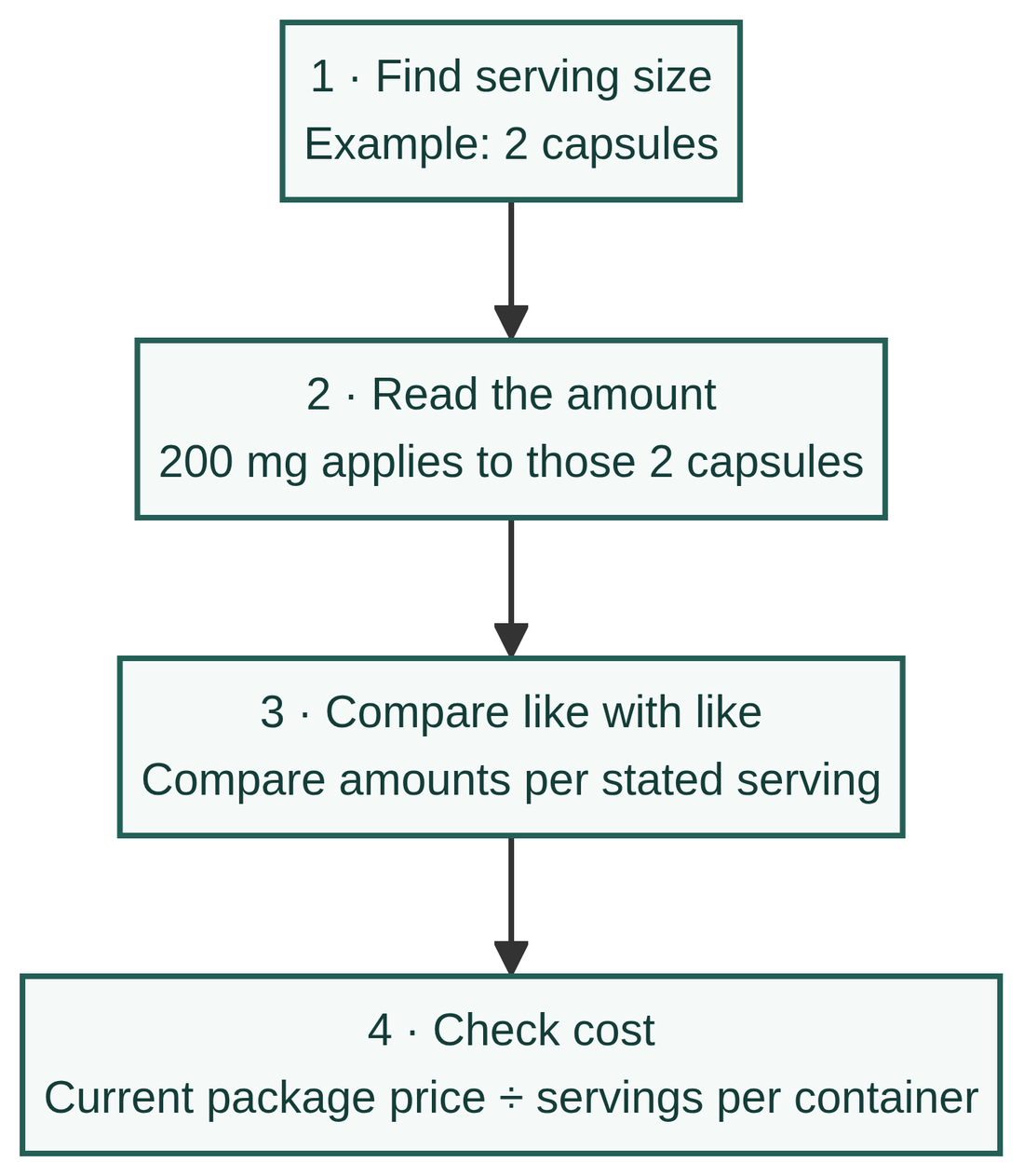
On a U.S. dietary supplement, find the Supplement Facts panel and its serving size. The listed ingredient amounts refer to that serving, which might be two capsules rather than one. [1] For a fictional label listing 200 mg per two capsules, one capsule corresponds to 100 mg and four capsules to 400 mg. This arithmetic describes the label; it does not establish how much anyone should take.
Next, compare servings per container and the current price. A $24 bottle containing 60 capsules at two capsules per serving has 30 servings, or $0.80 per labeled serving. If directions call for more than one serving a day, calculate the daily cost separately. Shipping and subscriptions can change the comparison, and a lower price does not settle questions of quality or suitability.
Put the amount and % Daily Value in context
The % Daily Value (%DV) shows how much one serving contributes toward a reference amount for a nutrient. For example, FDA lists the Daily Value for vitamin D as 20 micrograms (mcg), so a serving with 10 mcg provides 50% DV. [2] A Daily Value is useful for comparisons, but it is not an individualized requirement or a safe upper limit. Food, fortified drinks, and other supplements may add to the total. [3]
Read the unit as well as the number: 1 milligram (mg) equals 1,000 mcg. Some ingredients have no established Daily Value; the panel will say so rather than supplying a percentage. [5] That does not mean the ingredient is unsafe, safe, ineffective, or needed. A high percentage alone is not a quality score, and excess amounts of some nutrients can cause harm. [3]
Identify the ingredient and the blend
Compare the full ingredient name, amount, and form, not merely the bold number on the front. For a botanical, note whether the label describes an extract or a plant part; an extract's weight does not by itself reveal how it compares with the amount used in a particular study. The panel lists dietary ingredients with no Daily Value by amount, subject to the proprietary-blend rules. [5]
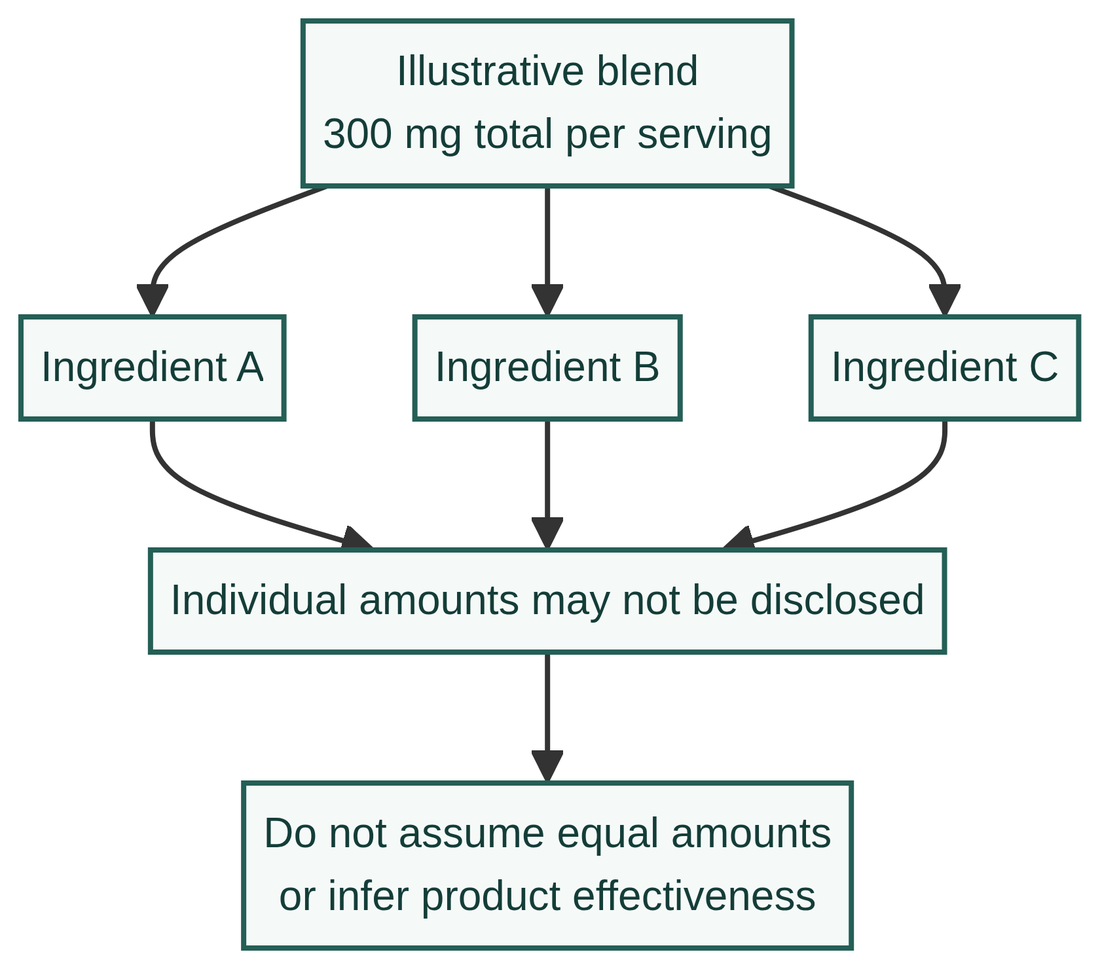
A proprietary blend can show the combined weight while leaving individual ingredient amounts undisclosed. Its listed blend ingredients are ordered by weight, but that order does not tell you the exact amount of each. [5] If an ingredient is important to your comparison, an unspecified amount makes it harder to judge against research or another label; asking the company may or may not resolve the gap.
Read the rest of the package
Check the other-ingredients list for things such as capsule materials, sweeteners, flavors, and fillers, plus anything you need to avoid. [1] FDA's major-allergen labeling rules apply to supplements: the allergen source may appear in the ingredient name or in a separate ‘contains’ statement. Advisory ‘may contain’ statements are not required, so their absence is not a guarantee against cross-contact. [6]
Look at suggested use, warnings, storage directions, company contact details, and any date on the exact flavor and format you are considering. FDA does not require an expiration date on every supplement label; if a firm provides one, it must be supported by valid data. [7] If a listing has only a front-of-package photo, request the complete current label before comparing.
Verify quality claims rather than brand stories
Independent testing and certification programs differ. NSF describes label-claim, ingredient-safety, and contaminant reviews, along with ongoing audits and retesting for its certification program. [4] Look up the exact product and current certification status with the named certifier; a claim about one product is not necessarily a claim about every formula from that company. A test report is also worth checking for its date, batch, and scope.
For athletes subject to testing, NSF Certified for Sport includes screening for specified banned substances and ongoing monitoring. It reduces certain risks; it cannot guarantee every possible risk or the absence of an anti-doping violation. [8] A seal does not prove effectiveness or individual safety. [3] Likewise, being a newer brand—or lacking a published certificate—is not proof that a product is poor quality; brand age alone is not a test.
Separate label promises from evidence
Dietary supplements are not intended to diagnose, treat, cure, or prevent disease, and dietary supplements are not FDA-approved before marketing for safety and effectiveness in the way new drugs are. [1] A ‘supports’ statement is often a structure/function claim and carries a required disclaimer that FDA has not evaluated the claim. Certain disease-risk health claims follow different FDA pathways. Some new dietary ingredients require advance safety notification; neither a notification nor a permitted claim is approval of the product. [1] [9]
A study of an ingredient is not automatically evidence for the complete formula, a different amount, or the outcome advertised. Ask what was tested, in whom, and for how long. FTC requires health-product advertising claims to be truthful, not misleading, and supported by appropriate evidence; a testimonial alone does not establish a benefit. [10] ‘Natural’ is not a safety guarantee, either. [11]
Apply the same checks to powders and sleep blends
Protein powders can be labeled as foods or supplements; compare grams of protein per serving, not just the weight of a scoop. Food can meet many athletes' protein needs, and a powder is a possible convenience rather than a universal requirement. Timing advice depends on the activity and eating pattern; a package cannot establish that everyone needs a shake immediately after exercise. [12]
For pre-workout blends, check the serving and any separately stated caffeine amount, and consider caffeine from drinks and other products. If caffeine is not quantified separately, the blend's total weight does not reveal how much caffeine it contains. More caffeine can disturb sleep or cause anxiety, and evidence differs across performance ingredients; a long list does not prove the combination works. [5] [12]
For a sleep blend, check whether it contains melatonin and what else is included. Evidence depends on the sleep problem: NCCIH says evidence is not strong enough to recommend melatonin for chronic insomnia, and its long-term safety remains unclear. A sleep claim or larger serving does not establish a better result; persistent sleep problems deserve professional evaluation. Keep such products out of children's reach. [13]
Consider the whole health picture
A label cannot tell you whether you need a supplement or how it will interact with your circumstances. For example, vitamin K can interfere with warfarin, and taking several products can add overlapping nutrients. [3] Bring a list or photos of your medicines, supplements, and their amounts to a clinician, pharmacist, or dietitian, especially if you have a health condition, are planning surgery, are pregnant or nursing, or are considering a product for a child. [3] [11]
If a product causes a concerning reaction, stop using it and contact a health professional; seek urgent help when symptoms are serious. FDA accepts reports of suspected problems even when the cause is uncertain, and the package contact and lot details can help identify the product. [1] Choosing not to buy is also a reasonable outcome when the label or evidence does not answer your questions.
A few more things
Frequently asked questions
Can I tell how much of each ingredient is in a proprietary blend?
Not necessarily. The label can list a blend's total weight and its ingredients in descending order by weight without giving every ingredient's individual amount. Ask the manufacturer if you need more detail, but it may not provide it. [5]
Is a supplement without an expiration date automatically illegal?
No. FDA does not require an expiration date on every dietary supplement. A company that provides one must support it with valid data; follow any storage directions and contact the company if you have questions. [7]
Does FDA registration or an ingredient notification mean the product is FDA-approved?
No. Facility registration and the safety notifications required for some new dietary ingredients are distinct from approval of a supplement for safety and effectiveness before marketing. Certain label claims also have their own rules. [1] [9]
For the curious
Sources and further reading
Explore the original guidance for more detail. Sources checked .
- FDA: Questions and Answers on Dietary Supplements
- FDA: Daily Value on the Nutrition and Supplement Facts Labels
- NIH Office of Dietary Supplements: Dietary Supplements—What You Need to Know
- NSF: Supplement and Vitamin Certification
- FDA: Dietary Supplement Labeling Guide—Nutrition Labeling
- FDA: Food Allergies
- FDA: Dietary Supplement Labeling Guide—General Labeling
- NSF: Certified for Sport Program
- FDA: Label Claims for Conventional Foods and Dietary Supplements
- FTC: Health Products Compliance Guidance
- NIH NCCIH: Using Dietary Supplements Wisely
- NIH Office of Dietary Supplements: Dietary Supplements for Exercise and Athletic Performance
- NIH NCCIH: Melatonin—What You Need To Know