
A quick read
The short version (TL;DR)
- An outside laboratory can test a sample for specified things; that is not necessarily an ongoing, independent product certification.
- Check the organization, standard, exact product, test scope, date, and lot where relevant. A facility's GMP certification is not automatically certification of every product.
- Dietary supplements are not FDA-approved for safety and effectiveness before marketing as drugs are, and they are not intended to diagnose, treat, cure, or prevent disease. [1]
- A quality seal does not establish that a supplement works for your goal, is suitable for you, or is free of every possible contaminant. [2]
Start with the question a test can answer
Third-party testing generally means an organization separate from the manufacturer or brand tested a sample. The useful question is not simply ‘Was it tested?’ but ‘Who tested what, for which substances, using what criteria, and when?’ A laboratory might check the identity or quantity of a labeled ingredient, look for specified contaminants, or do both. A single test result describes the sample and methods involved; it does not automatically describe every bottle, future batch, or effect on the body.
In the United States, dietary supplements are not FDA-approved for safety and effectiveness before marketing in the way drugs are. They are not intended to diagnose, treat, cure, or prevent disease. Manufacturers and distributors are responsible for complying with applicable safety and labeling rules, while FDA inspects facilities, reviews reports, monitors the market, and takes action when appropriate. That regulatory framework makes an understandable quality claim useful, but it does not make a private seal equivalent to a drug approval. [1]
The details of FDA oversight are not all the same. For certain new dietary ingredients, advance notification with safety information is required, subject to exceptions; notification is not FDA approval of the finished supplement. Certain permitted health claims about a substance and reduced disease risk have their own review or authorization processes, while structure/function claims follow different rules. Neither fact means that a supplement has been approved like a medicine. NIH also cautions that independent quality seals do not guarantee safety or effectiveness. [1] [2]
Do not confuse a regulatory record with a quality test. FDA says certain facilities must register with the agency; registration does not mean FDA has approved or tested every product made there. Likewise, a manufacturer can be responsible for supporting its claims without FDA having evaluated each claim before use. Ask what the specific record or statement establishes, rather than treating every reference to FDA as the same type of action. [1]
Separate a test, a product certification, and a facility audit
A one-time laboratory test asks a defined question about a particular sample. For example, a company might send one finished powder batch to an outside lab for lead testing, or it might obtain an ingredient supplier's analysis before production. Those are different tests: evidence about an incoming ingredient alone does not establish the contents of the finished powder. Neither example, by itself, tells you whether other contaminants were checked or whether an independent organization continues to supervise the product.
Product certification is a broader claim only when the named program makes it so. For example, NSF describes NSF/ANSI 173 dietary-supplement certification as involving a technical and label review, product and contaminant testing, and GMP certification as a prerequisite. NSF also describes a toxicology review of intentionally added ingredients, annual audits, and periodic retesting. These are features of that program, not assumptions to make about every seal. NSF's sport program adds a separate prohibited-substance screen. [3] [4]
Facility or GMP certification focuses on manufacturing systems and processes. It is not the same as independent certification of the contents of every product made there. Separately, FDA's dietary-supplement current good manufacturing practice rules require firms to establish specifications and use appropriate verification; FDA guidance describes testing or examination of a statistically selected subset of finished batches unless every batch is verified, with documented exceptions for some specifications. Legal GMP obligations and a voluntary outside certification are related but distinct. [3] [5]
Within a testing program, the actual panel matters. NSF describes checks that can include toxic elements, particular microorganisms, pesticides, and mycotoxins, as well as ingredient and label verification. Ask which of these apply to the product and what limits or criteria are used; do not assume that a heavy-metal panel also checks for every possible allergen, undeclared drug, or sport-banned substance. ‘Tested for contaminants’ is a starting point for a question, not a complete inventory. [3]
Use a three-way comparison instead of a logo contest
Imagine three fictional labels. Label A says only ‘third-party tested.’ Label B identifies an outside lab and provides a recent report for a named finished-product lot, but the report covers only lead. Label C names an independent product-certification program and has a current directory entry for the exact formulation. B tells you more than A about a particular test; C may provide broader continuing oversight, depending on the program. Neither B nor C proves all hazards are absent or establishes that the product works. These are illustrations, not actual product assessments.
Now change one detail: C displays a facility GMP mark, not a finished-product mark. That may describe audited manufacturing systems, but it cannot be read as an assurance that the specific powder has passed a particular contaminant panel. Conversely, a report without a certification mark can still provide useful evidence about its stated test. The meaningful comparison is the evidence's scope, who performed or reviewed it, and whether it applies to the product in hand—not how impressive the badge looks.
It is common for a brand to commission and pay an outside laboratory. Payment alone does not tell you whether the work was independent or reliable; ask who selected the sample and whether the report or certification can be authenticated. Accreditation can be another useful signal, but check the lab's scope for the relevant method. NIST notes that accreditation evaluates competence for specific tests, can include in-house labs, and is not a guarantee of results or product certification. [6]
Sampling is another useful distinction. A lab may receive a sample submitted by the company, while a certification program may have its own rules for sampling, audits, and follow-up. Ask who collected the sample, whether it was a finished product or raw material, how many lots are represented, and what happens when a result falls outside a specification. An outside lab's name alone does not answer those questions; nor does commissioning a lab prove that anything was done improperly. [5]
Read a certificate of analysis without overreading it
A certificate of analysis, or COA, is a report of specified tests and results; it is not automatically proof of independent certification. Ask for the report for the finished product and lot you are considering, rather than a generic ingredient sheet or an unrelated batch. Check the product and lab names, sample description, lot or batch number, sample and report dates, substances tested, methods, numerical results and units, and the specifications or limits used for any pass/fail judgment. The report may not be publicly available; you can request it from the brand and ask whether the lab can authenticate it.
‘Not detected’ is not the same as ‘proven absent.’ It usually means the substance was not found above the relevant method's detection or reporting limit; ask the lab how its particular qualifier is defined. For example, a report that checks lead but does not mention mercury cannot establish anything about mercury. If a measured result appears, compare it with the report's stated criterion in the same units rather than assuming any detected amount means a failure. CDC's laboratory guidance similarly cautions readers to check how each lab defines its qualifiers. [7]
Units and serving size matter. In a fictional report, a concentration of 0.20 milligrams per kilogram in a powder corresponds to 2 micrograms in a 10-gram serving; the calculation describes the hypothetical amount, not whether it is acceptable. A different serving produces a different exposure. Ask which standard supplies the limit and how it applies, and do not treat one number as a complete risk assessment: other exposures and individual circumstances matter too. FDA monitors toxic elements including lead, arsenic, cadmium, and mercury in foods and supplements. [8]
Pay attention to the comparison as well as the result. A ‘pass’ needs a stated specification: which standard or company criterion was used, and is the test's reporting limit low enough to assess it? A report that gives only a green checkmark without identifying the substance or limit is harder to interpret. The report date is not the same as the product's expiration date, and a test of one batch does not automatically document stability throughout its shelf life. Ask for clarification rather than inferring a result that is not shown.
Worksheet: verify the exact claim before buying
Record the product name, company, flavor, form, serving size, and any identifying code or lot number you can see. Write down the exact claim and mark: ‘tested,’ ‘facility GMP certified,’ ‘contents certified,’ or ‘sport certified.’ Then note who supposedly made the determination. If the marketing page does not name an organization or describe the scope, mark those fields ‘unknown’ rather than filling them in from the logo's appearance.
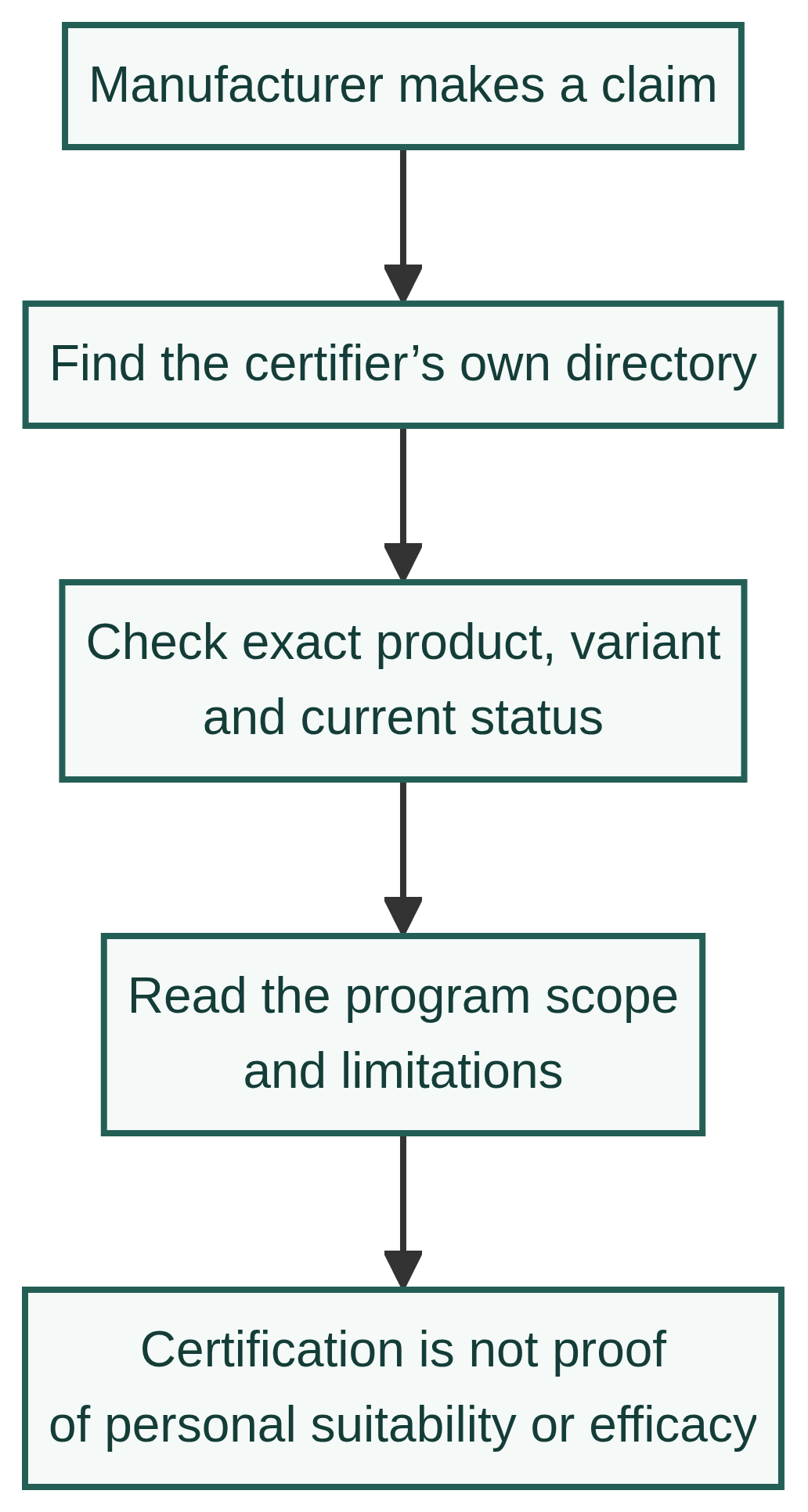
Go to the named certifier's own directory, not just a retailer image or a screenshot supplied by the brand. NSF has an official dietary-supplement directory; compare the listing with the exact product and the certification described. Look for current status and any details distinguishing formula, flavor, format, or product code. A listing for another item from the same brand is not enough, and an old screenshot cannot establish current status. If the listing does not show the detail you need, ask the certifier. [9]
For NSF Certified for Sport, NSF says tested lots are listed online or in its app; its sport directory can be searched by product, company, or lot number. Match the actual lot where available, not merely the product name. If the lot is not yet visible, the packaging and listing disagree, or the product is unavailable for inspection before purchase, ask the seller and certifier how to verify it. Do not assume that a general NSF dietary-supplement listing automatically confirms sport certification. [10] [11]
Finish the worksheet with four lines: ‘Scope checked: ___’; ‘Product and lot match: yes / no / unclear’; ‘Current status confirmed on: ___’; and ‘Unanswered questions: ___’. Send a concise inquiry: ‘Is this exact flavor and lot covered, what is tested, and is monitoring ongoing?’ A missing listing or unavailable report means the claim remains unverified; it does not by itself prove the product is unsafe. A newer brand is not automatically lower quality, and an established brand's age is not proof of quality for a particular item.
Read nextUse the label-reading guide alongside this worksheet
For tested athletes, check the sport-specific layer
A general quality screen and a sport screen answer overlapping but different questions. NSF describes Certified for Sport as including label and formulation review, facility and supplier inspections, ongoing monitoring, and testing of production lots for substances on its specified banned-substance panel. A general contaminant or heavy-metal report does not demonstrate that prohibited stimulants or other sport-relevant substances were part of that test. Even a sport-specific panel covers named substances and methods, not every conceivable prohibited compound or future rule change. [10]
Use the directory to match product details and lot, and check the current requirements of your governing organization. The U.S. Anti-Doping Agency warns that marks can be misused and advises checking the actual product and batch, or confirming directly with the certifier. It also explains that athletes can be responsible for prohibited substances found in their bodies even when a supplement was contaminated. Certification can reduce a defined risk; it does not guarantee a negative test or prevent every anti-doping violation. [11] [12]
An illustrative contrast: a protein powder has a current general contents certification, while a different powder has a current sport-specific listing for the lot in hand. The first may address the program's contents criteria; without more information it does not establish a sport-screen result. The second has a defined additional screen, not a promise of performance or a blanket exemption from sport rules. Neither scenario establishes a real product's current status, and either shopper can decide not to use a supplement.
A useful athlete's record includes the directory listing and date checked, exact name and flavor, lot number, a photo of the label, and the sport organization's current guidance. Review it with your team medical or anti-doping contact if you have one. Check any declared ingredients against the relevant rules as well: a certification panel is not permission to ignore a substance listed on the label. Keep the record if you use the product, since details may be needed later. [10] [12]
Apply the same logic to protein, pre-workout, and sleep
For protein powder, ask whether a report or certification actually covers the stated protein amount and the contaminants of interest, then check the complete ingredient and allergen information. A measured amount of protein is not evidence that a shake has a special post-workout window. NIH notes that athletes can often meet protein needs through food, while supplements may be convenient; its sports-nutrition guidance discusses eating protein around training and throughout the day. Needs and schedules differ, so a certified powder is neither mandatory nor an individualized timing plan. [13]
For a hypothetical pre-workout, a sport screen can address its specified prohibited-substance panel, but it does not make the labeled stimulant dose suitable for every person. Check the serving size and caffeine amount, including caffeine from other products. NIH notes that caffeine affects people differently and can disturb sleep or cause anxiety; evidence for ingredients also varies, and citrulline performance research is limited. A long ingredient list or a proprietary blend with undisclosed individual amounts makes the evidence harder to apply to the complete formula. [1] [13]
For a sleep gummy, a verified ingredient-amount test can help answer a content question, but it does not prove better sleep or establish long-term safety. NCCIH reports that melatonin supplements have shown labeling discrepancies in small studies, and that evidence is insufficient to recommend melatonin for chronic insomnia; long-term safety information is limited. Sleep problems have different causes. Speak with a health professional about persistent difficulty, medicines, pregnancy or breastfeeding, and especially before giving melatonin to a child; store supplements out of children's reach. [14]
For a multivitamin, a matching test for iron or vitamin K would help answer whether those named nutrients were present at the evaluated amounts; it would not establish that the amounts are needed or appropriate for a particular person. Add up overlapping nutrients from other supplements and fortified foods, and discuss relevant medicines with a clinician or pharmacist. For example, NIH notes that vitamin K can reduce the effect of warfarin. The certification question and the interaction question remain separate. [2]
Keep quality, evidence, and personal suitability separate
Think in three columns. Quality asks: Does the available evidence support the stated contents and specified contaminant limits? Effectiveness asks: Is there credible research on this ingredient or complete formula, in people and for the outcome claimed? Suitability asks: Does the product make sense alongside this person's diet, medicines, health, and circumstances? A good answer in one column does not fill in the other two. An accurate label is useful even when the benefit is uncertain; an appealing benefit claim does not repair an unclear quality claim.
When a seller says ‘clinically tested,’ ask whether the study examined the whole current formula or just one ingredient, what outcome was measured, and whether the people and conditions resemble the advertised use. A test tube, animal study, testimonial, or before-and-after story does not by itself establish a benefit in people. FTC guidance says health-benefit claims need competent and reliable scientific support and that claims about the level of evidence must themselves be accurate. A laboratory quality test is not a clinical trial. [15]
Even accurately labeled ingredients can cause side effects, overlap with other supplements or fortified foods, or interact with medicines. Ask a clinician or pharmacist to review the full label and your medicines when appropriate, particularly if you have a health condition, are pregnant or breastfeeding, are considering a product for a child, or have surgery planned. A seal is not a substitute for that conversation, and choosing no supplement is an entirely reasonable outcome when the reason for using one is unclear. [2]
For a practical comparison, make a row for each option—including taking nothing—and columns for quality evidence, evidence for the intended benefit, personal questions, and remaining unknowns. A product with a well-documented contaminant screen but no relevant human evidence should have a blank benefit column, not an automatic positive mark. Another might have relevant ingredient research but no verifiable product-specific test. The worksheet does not calculate a winner; it makes the missing information visible before a decision is made. [2] [15]
A final checklist and what to do if something goes wrong
Before checkout, check five items: the exact product and serving; the named testing organization or certifier; the substances or claims evaluated; whether the report or listing matches the current product and relevant lot; and what remains unknown. Then read ingredients, allergen information, suggested use, expiration and storage instructions, cost per serving, and purchase terms. A seller who supplies only a badge or refuses to clarify the scope leaves you with less information, not a basis for inventing a safety conclusion.
Search FDA's recall and safety-alert resources using the product and company name, and compare the details and affected lots with your package. FDA explains that its public recalls page includes certain announcements but not all recalls, so an empty search is not proof that a product is problem-free. A recall, a market withdrawal, and a safety alert are not interchangeable labels; read the actual notice and follow its instructions. Save the package, lot number, and receipt where practical. [16]
If you suspect a serious reaction or illness, stop using the product and seek appropriate medical attention promptly; for an emergency, call emergency services. FDA asks consumers to report suspected supplement problems through its Safety Reporting Portal, even if they are unsure the product caused the problem. Provide the product name, lot, what happened, and other relevant details if available. A report helps FDA monitor safety but does not by itself establish causation. [1] [17]
A few more things
Frequently asked questions
Does third-party testing mean the supplement works?
No. An analytical test can address specified contents or contaminants; it is not a clinical trial showing that the product produces a particular benefit. Evaluate the evidence for the exact claim separately. [15]
Does ‘not detected’ mean a contaminant is completely absent?
No. A nondetect result is limited by the method and its reporting or detection limit; definitions can vary by laboratory. It says nothing about substances that were not tested. [7]
Is an accredited lab the same thing as an independently certified product?
No. Accreditation concerns a laboratory's competence for tests within its accredited scope; it is not certification of a particular product and does not itself prove the lab is independent of the manufacturer. [6]
What if a brand will not share a report or I cannot find its product in a directory?
Ask the company and the named certifier what is covered and whether the exact product or lot can be verified. Until you have an answer, treat the claim as unconfirmed; the absence of a public report or listing alone does not establish that the product is unsafe. NSF maintains a directory for checking its certified dietary supplements. [9]
Is a newer supplement brand less trustworthy than a long-established one?
Not automatically. Brand age and size do not establish the quality of a particular formulation. Compare the exact label and independently verifiable testing or certification, and be honest about information you cannot confirm. NSF's product certification program assesses specified product criteria, rather than relying on the company's age. [3]
Can a certified sleep product still interact with a medicine?
Yes. Quality certification does not eliminate interactions or prove an ingredient is appropriate for you. Discuss the full label with a clinician or pharmacist, particularly for melatonin and other products used alongside medicines. [2] [14]
For the curious
Sources and further reading
Explore the original guidance for more detail. Sources checked .
- FDA: Questions and Answers on Dietary Supplements
- NIH Office of Dietary Supplements: Dietary Supplements—What You Need to Know
- NSF: Dietary Supplements and Functional Foods FAQs
- NSF: Supplement and Vitamin Certification
- FDA: Small Entity Compliance Guide to Dietary Supplement Current Good Manufacturing Practice
- NIST: National Voluntary Laboratory Accreditation Program
- CDC/ATSDR: Evaluating Sampling Data
- FDA: Environmental Contaminants in Food
- NSF: Certified Dietary Supplements Directory
- NSF: What Does It Take to Be Certified for Sport?
- NSF: Certified for Sport Product and Lot Search
- U.S. Anti-Doping Agency: Always Verify Third-Party Certified Logos on Supplements
- NIH Office of Dietary Supplements: Dietary Supplements for Exercise and Athletic Performance
- NIH NCCIH: Melatonin—What You Need To Know
- FTC: Health Products Compliance Guidance
- FDA: Recalls, Market Withdrawals, and Safety Alerts
- FDA: How to Report a Problem with Dietary Supplements