A quick read
The short version (TL;DR)
- Pre-workout is optional. Some ingredients may help with certain activities, but individual responses differ and the evidence on complete combinations is often limited. [1]
- Count caffeine from drinks, medicines, and supplements together. The FDA’s reference amount for most adults is not a goal or a personal safety guarantee. [2]
- A short-lived boost may not be worth disrupted sleep or unpleasant symptoms. Talk with a health professional about concerning reactions. [2] [3]
- Compare transparent amounts, verification, and actual cost with the option of training without a powder. A decision not to buy is a valid outcome.
Start with the decision, not the scoop
A pre-workout is a product marketed for use before exercise, not a necessary stage of a workout. Formulas vary: some rely on caffeine, while others combine several ingredients or contain no caffeine at all. The useful question is not whether pre-workout is good or bad in general. It is whether a particular product offers enough relevant benefit to justify its drawbacks for a particular person, session, and schedule.
There is a case for nuance. NIH reviews research suggesting that caffeine may improve performance in some activities, especially endurance and longer intermittent efforts, while responses vary. That does not establish that every pre-workout helps, that extra caffeine helps more, or that an ingredient studied alone has the same effect in a mixture. Many multi-ingredient products have not been studied as complete combinations. [1]
Before comparing tubs, finish this sentence: ‘For this workout, I want help with _____.’ A person hoping to feel more awake on the way to an easy session has a different question from an athlete seeking a measurable improvement in a specific event. Feeling alert, enjoying a flavored drink, lifting more weight, and recovering well are different outcomes; noticing one does not prove the others. For a useful decision, make the outcome observable: completing a planned session, a particular measured time, or simply finding the routine convenient. Decide in advance what improvement would matter enough to justify paying for a product, while recognizing that an individual observation cannot establish that the powder caused it.
Then name the costs you would actually care about: less sleep, a racing feeling, money spent, a complicated routine, or uncertainty about what is in the scoop. It is reasonable to decide that none is acceptable for a marginal or uncertain benefit. This guide offers information for that decision, not a personalized supplement plan or a verdict on an individual product.
When caffeine from the whole day adds up
A caffeine calculation starts with what you actually consume, not just the number printed on the front. Read the serving size and the caffeine amount per serving, then account for your actual portion. Add other sources, including coffee, tea, energy drinks, chocolate, medications, and other supplements. Guarana and some other botanical ingredients can also contain caffeine. If an amount is unavailable, mark it unknown rather than counting it as zero. [1] [2]
Worksheet, using invented numbers: a label lists 200 milligrams of caffeine per two-scoop serving. If the portion used is 1½ scoops, that portion contains 150 milligrams, assuming the powder is evenly mixed and the label is accurate. Add a hypothetical coffee with 100 milligrams and an energy drink with 120 milligrams: the known total is 370 milligrams. Actual drinks, portions, and labels vary; these numbers are arithmetic examples, not typical or recommended amounts.
The FDA cites 400 milligrams a day as an amount not generally associated with negative effects for most adults, while emphasizing wide differences in sensitivity and caffeine clearance. It is not a quota, a dose to aim for, or a guarantee that 370 milligrams—or a lower total—is appropriate for you. Certain conditions and medicines can increase sensitivity; pregnancy, trying to conceive, and breastfeeding warrant a conversation with a health professional. [2]
For a useful personal tally, write: product and amount per labeled serving; actual serving fraction; caffeine from each other source; known total; and anything unknown. Note the time as well as the amount. If a manufacturer cannot clarify a missing quantity, the tally stays incomplete. If you routinely use caffeine and wish to cut back, the FDA notes that gradual reduction can make withdrawal less unpleasant; ask a clinician if you need help. [2] If a label says its stated caffeine total includes all sources, do not add the guarana portion a second time. If the label is unclear about whether botanical caffeine is included, ask the company; an answer that does not quantify it leaves the total uncertain. Restaurant drink sizes and recipes also vary.
When the boost borrows from sleep
A workout may feel easier to start after a stimulant, but the time of day matters. NIH notes that caffeine can interfere with sleep and that its effects can last up to eight hours. That is not a universal safe cutoff: sensitivity, dose, schedule, and the time it takes to clear caffeine vary. An evening training session followed by an early bedtime is an especially sensible time to question whether a caffeinated powder is worth it. [2] [3]
Contrast two hypothetical schedules. One person trains in the morning and has no apparent sleep disruption; another takes a caffeinated scoop before a late class and has trouble falling asleep. The second person has a clear reason to reconsider the product. The first has not proved the powder is safe or beneficial, and the second cannot know from one night alone that the powder was the sole cause.
A short sleep log can make the tradeoff more visible: record bedtime and wake time, approximate sleep, caffeine amount and time, exercise time, and anything else that changed, such as shift work or stress. Look for a recurring pattern rather than treating a single night as proof. A log is not a diagnostic test, and sleep difficulties can have many causes. If symptoms persist or affect daily life, seek professional advice. [3] For shift workers, the relevant bedtime may be in the morning rather than at night, so clock time alone can be misleading. Record the interval between caffeine and your intended sleep, and bring a few entries to a clinician if the pattern worries you. [3]
The practical alternative might be a caffeine-free session, an earlier training time when feasible, or a routine that makes enough time for rest. Not everyone can move a shift or avoid evening exercise, and sleep advice is not a substitute for support with a sleep disorder. If you experience insomnia, jitters, palpitations, anxiety, or another concerning symptom, do not increase the dose to chase the original feeling; discuss symptoms with a health professional. [2] [3]
When a simpler session fits the goal
For a familiar, moderate workout, the no-powder option may be straightforward: arrive with water available, wear comfortable equipment, and give yourself enough time for a manageable warm-up. A meal or snack that agrees with you can be useful if it fits your schedule. These are practical options, not a promise that every workout will feel energetic or that one meal and one amount of fluid suit everyone.
For example, someone doing an easy lunchtime walk after breakfast may prefer ordinary water and a normal lunch afterward. Someone training for a long event in heat may need a more deliberate food and fluid plan, particularly when sessions are prolonged or close together. The second scenario is not an automatic reason to buy a stimulant blend: a sports dietitian or other qualified professional can help tailor the plan to the activity and conditions. Planning might mean packing a familiar snack or making a meal accessible after training, rather than buying a separate performance formula. What and when you eat can depend on appetite, how long the session lasts, tolerance, and your access to food; the examples are not a universal fueling prescription.
Protein timing also deserves context. NIH notes that athletes can obtain protein from foods and that sports-nutrition guidance sometimes places protein within the first two hours after exercise and at intervals afterward. Overall intake and the surrounding meals matter, too; the evidence does not make an immediate shake compulsory for every person and session. A powder can be convenient, but it is not interchangeable with a pre-workout stimulant. [1]
If you feel flat every day, consider whether your schedule allows enough food, fluids, rest, and recovery, without assuming that any one is the cause. A workout log can help you describe the pattern, but it cannot diagnose fatigue or rule out a health problem. Persistent, unusual, or disruptive fatigue is a reason to consult a clinician rather than covering it with progressively stronger products.
When the ingredient evidence does not match the promise
Caffeine has evidence for some performance outcomes, but results vary by person and type of exercise. Feeling stimulated is not the same as improving a particular time, lift, or skill, and more caffeine can increase side effects without improving performance further. Evidence for a single ingredient at a particular amount and schedule does not prove a different, multi-ingredient formula produces the same effect. [1]
Beta-alanine illustrates why timing and sensations matter. Some studies report small benefits for certain high-intensity, intermittent activities after regular use over weeks; others do not. It can cause tingling, but that sensation is a side effect, not a reliable indicator that a single workout will improve. The performance evidence for citrulline is limited, and its safety has not been studied enough to settle every question. [1]
Creatine is different again: NIH describes evidence for improved performance in repeated short, intense efforts after use over time, with less apparent value for endurance activities. Its presence in a pre-workout does not establish that a one-time scoop immediately before exercise will deliver those researched effects. Nor does it establish that a combination or amount in an unspecified product matches a study. [1]
Use a claim-matching worksheet: identify the promised outcome; the ingredient or exact combination studied; the amount and duration; the people and activity studied; and what researchers measured. Ask whether the label lets you make that comparison. A plausible mechanism, a long ingredient list, or a dramatic testimonial is not a substitute for evidence on the relevant outcome. If key details are missing, ‘uncertain’ is a useful conclusion. [1] A human trial that measures an actual performance outcome against an appropriate comparison is more informative for that outcome than a laboratory explanation alone. Even a promising individual study must be considered alongside other research, including studies that found no effect; size, duration, and participant characteristics limit what can be inferred. [1]
When the label or price makes comparison impossible
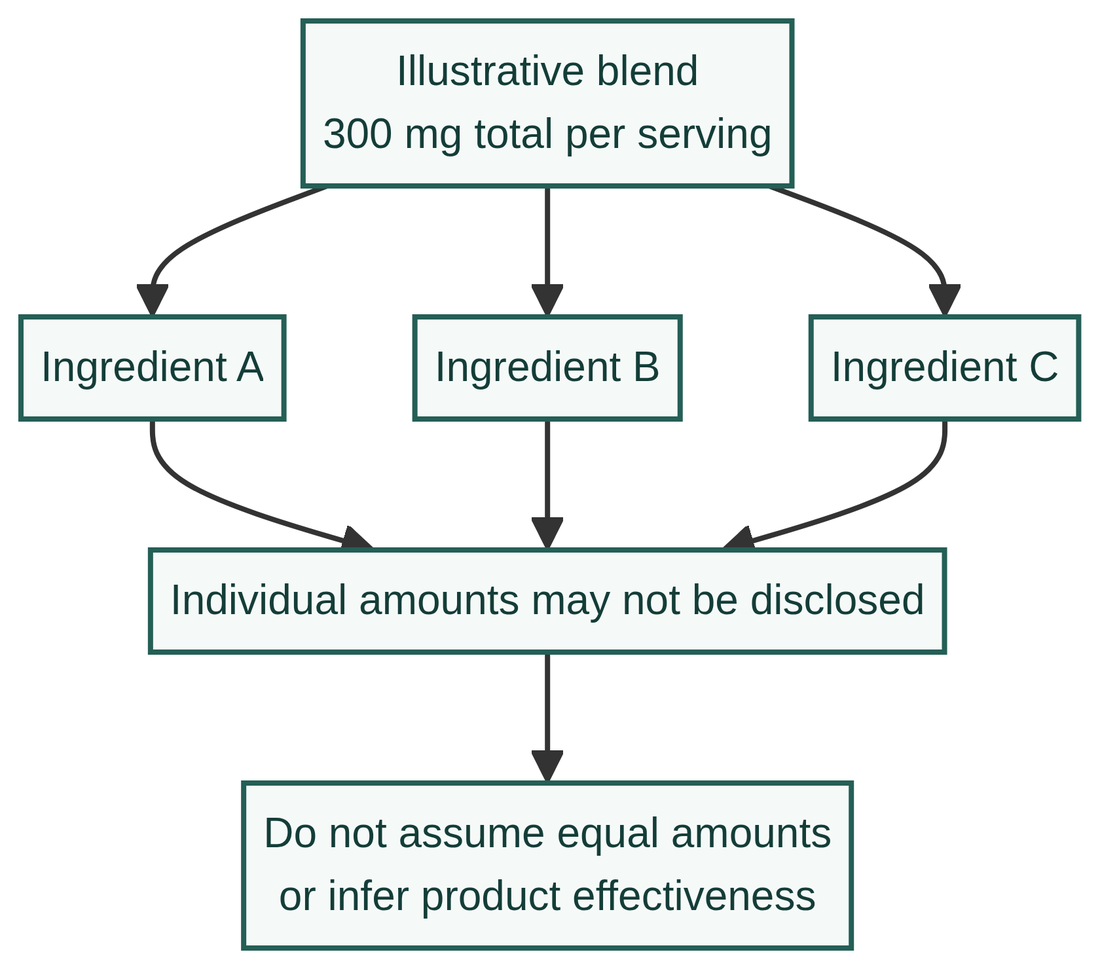
Start with the Supplement Facts panel: serving size, servings per container, listed ingredients, and amounts for the stated serving. A proprietary blend generally gives the blend’s total weight but not each component’s amount. If an ingredient is inside such a blend, you cannot infer its individual quantity from the total. Check the other-ingredients list, allergens, flavor, and the version you would actually receive. [4]
For price, divide the current total price by the number of labeled servings, then adjust for the portion you actually use. In an invented example, a $36 tub with 30 labeled servings costs $1.20 per labeled serving before shipping or tax. At three labeled servings a week for four weeks, the calculated product used costs $14.40; the checkout outlay for the tub is still $36. A two-scoop serving is not 30 individual one-scoop uses. In this example the tub would contain 60 scoops if every labeled serving were two scoops. Someone using one scoop would calculate $0.60 of product per use, but would also receive half of each evenly distributed labeled ingredient amount—not a full studied serving by default.
Write down the one-time price, shipping, taxes, renewal frequency, cancellation steps, and any minimum commitment. A discount is not useful if it leads you to buy more than you want. An expensive powder can be a poor fit even if its label is transparent; a low price does not establish quality or suitability. Prices and formulas change, so inspect the current exact listing rather than relying on an old review.
Read an advertisement as a claim to investigate, not as evidence by itself. FTC guidance says health-product advertising should be truthful, not misleading, and backed by appropriate scientific evidence; research should be relevant to the product and claim. A testimonial, ‘clinically studied’ ingredient, or impressive graphic does not by itself show that the entire advertised blend works for your goal. [5]
When safety means pause or get help
Do not assume that ‘natural,’ stimulant-free, or sold online means appropriate for you. Concentrated caffeine can be especially dangerous: the FDA warns that pure and highly concentrated products can cause serious harm, including death. Avoid bulk products that require measuring tiny portions of concentrated caffeine; do not stack multiple stimulant-containing products to create a stronger effect. [2]
DMAA, also called 1,3-dimethylamylamine or methylhexanamine, is a separate red flag. The FDA says it is not a dietary ingredient, considers products marketed as supplements containing it illegal, and advises consumers not to buy or use them. It may present cardiovascular risks, especially with other stimulants. A label check helps but cannot establish that every unlisted substance is absent. [6] [7]
Ask a clinician or pharmacist to review the full label and your medications and supplements before use, especially if you have a medical condition, are pregnant or breastfeeding, or are considering a product for a child. Many supplements have not been tested in pregnant or nursing people or children, and interactions are possible. If a product causes side effects, stop taking it and contact a health professional; do not try it again simply to complete a self-test. [7] Bring a photo of the current Supplement Facts and other-ingredients panels, the amount taken, and a list of all prescriptions, over-the-counter medicines, and supplements. Do not stop or change prescribed medication on your own to make room for a workout product.
If someone has collapsed, is unconscious, is having a seizure, or has trouble breathing after a suspected exposure, call 911 immediately. For a suspected poisoning when the person is conscious and able to speak, call U.S. Poison Help at 1-800-222-1222 for individualized guidance; do not wait for symptoms to develop. For a suspected supplement reaction, the FDA also accepts reports through its Safety Reporting Portal, even if the cause is uncertain. [8] [4]
When quality claims are hard to verify
Dietary supplements are not FDA-approved before marketing for safety and effectiveness in the way drugs are. They are not intended to diagnose, treat, cure, or prevent disease. Companies have responsibilities for product safety and labeling; the FDA also inspects, reviews certain submissions, investigates reports, and can act against violations. Some new dietary ingredients require advance notification, but that is not FDA approval of the finished product. [4]
An independent certification can provide useful information about quality, but programs have different scopes. NSF describes label and formulation reviews, facility inspections, testing for specified banned substances, and ongoing monitoring for its Certified for Sport program. Verify the exact product and its current status in the certifier’s own database. Certification does not prove that a blend improves performance, is suitable for you, or is free of every possible hazard. [9]
Neither a newer company nor a long-established one earns a quality verdict from its age, size, packaging, or social following. Ask what was tested, by whom, when, and whether the claim applies to the exact formula or lot. A one-time laboratory report and continuing certification are not identical. A missing public report is a reason to ask questions, not proof of a defect; likewise, a logo without verification is not proof of current certification. [9] A batch report, if available, should identify what was measured and the batch and date it covers. A report limited to one contaminant cannot tell you about untested contaminants; an older report cannot by itself establish the contents of a newly reformulated product.
Check FDA information for the exact product or ingredient if you have a concern. Regulatory actions differ: a warning letter communicates alleged violations and requested corrections. [10] A recall removes a product from the market and may begin on a company’s initiative or be requested or ordered by the FDA. [11] An advisory can warn the public. Read each notice for its reason, affected product and lot, status, and instructions instead of treating all notices as equivalent. The absence of a notice is not a safety guarantee.
A practical keep-or-skip worksheet
Before buying or using a product, write five short answers: What exact session and outcome matter to me? What is the actual serving and known caffeine total for that day? When would I sleep? What does the product cost per actual use, including purchase terms? What independent information covers this exact formula? An unknown amount, unresolved safety question, or unclear claim can be enough reason to pause. Add a final line for your decision: skip, seek advice, or continue considering the purchase after resolving a named question. This makes a pause a deliberate choice rather than a problem to solve with another product.
Now list a workable comparison for the same situation: no powder; the meal or snack you already tolerate if it fits; water available; and a realistic session. If the attraction is flavor or convenience, name that honestly rather than calling it a demonstrated performance effect. If you already drink caffeine, include it in the day’s total instead of assuming a powder is the only source. [2]
Consider two more hypothetical decisions. A recreational lifter who likes a scoop but notices anxiety and poor sleep can stop it and discuss the symptoms rather than accepting those costs. A competitive athlete with a specific performance goal may want expert advice and exact-product sports certification; even then, a seal cannot guarantee an anti-doping outcome or prove the product will help. Consult the relevant sport’s rules. [2] [9]
If there is no safety concern and you choose to observe your usual no-powder sessions, note the activity, perceived effort, sleep, and schedule over time. Changes in training, expectations, food, and life stress make a personal log an imperfect comparison, not a controlled study or proof of cause. At the end, ask whether any claimed advantage is meaningful enough to justify the uncertainties and cost. ‘I do not know’ and ‘I do not need it’ are both valid answers.
A few more things
Frequently asked questions
Is pre-workout necessary for an effective workout?
No. Pre-workout is optional. Some ingredients may benefit particular activities, but a mixture is not a required part of exercise, and evidence for individual ingredients does not establish that every complete product works. [1]
Can I have coffee and pre-workout on the same day?
Both may add caffeine. Count all known sources and their timing, and remember that the FDA’s 400-milligram reference applies to most adults, not everyone. Sensitivity and medical circumstances differ; an unknown amount makes the total uncertain. [2]
Is a stimulant-free pre-workout automatically safe or effective?
No. Removing caffeine does not establish the safety or effectiveness of the remaining ingredients or their combination. Review the complete label, potential interactions, evidence, and applicable quality verification; ask a professional if you are unsure. [1] [7] [9]
Does a tingling feeling mean the workout is working?
No. Beta-alanine can cause tingling, and studies of its performance effects have used regular intake over time, with mixed results. A sensation immediately after a scoop does not prove a workout benefit. [1]
How long before bed should I stop caffeine?
There is no cutoff that guarantees good sleep for everyone. NIH says caffeine’s effects can last up to eight hours, while sensitivity and clearance vary. Consider your own schedule and speak with a health professional about persistent sleep difficulties. [2] [3]
Should a teenager use pre-workout?
Do not assume an adult product is appropriate for a teenager. Many supplements have not been tested in children, and caffeine can cause adverse effects. A parent or caregiver can discuss the full label and the teenager’s activity and caffeine intake with a qualified health professional. [2] [7]
Does a certified product guarantee an athlete will pass a drug test?
No. A sports certification can reduce certain risks through its defined screening and monitoring, but it is not a guarantee against every banned substance or anti-doping violation. Verify the exact product and consult the rules of the relevant sport. [9]
What should I do after a concerning reaction?
Stop the product and contact a health professional. Call 911 for collapse, unconsciousness, a seizure, or trouble breathing. For suspected poisoning, a conscious person able to speak can call U.S. Poison Help at 1-800-222-1222. You can also report a suspected supplement adverse event to the FDA. [7] [8] [4]
For the curious
Sources and further reading
Explore the original guidance for more detail. Sources checked .
- NIH Office of Dietary Supplements: Dietary Supplements for Exercise and Athletic Performance
- FDA: Spilling the Beans: How Much Caffeine is Too Much?
- NIH National Heart, Lung, and Blood Institute: Healthy Sleep Habits
- FDA: Questions and Answers on Dietary Supplements
- FTC: Health Products Compliance Guidance
- FDA: DMAA in Products Marketed as Dietary Supplements
- NIH National Center for Complementary and Integrative Health: Using Dietary Supplements Wisely
- America’s Poison Centers: When To Call Poison Control Help Line?
- NSF: Certified for Sport Program
- FDA: What’s New in Dietary Supplements
- FDA: Recalls Background and Definitions